
Ogilvy / The headline and copy playbook
The headline and copy playbook
Nine principles from Confessions of an Advertising Man on writing headlines and copy that get read, and two worksheets to apply them.
Principle 1 / Homework
Do the homework before you write
"too lazy to do this kind of homework" - David Ogilvy
- Become the best-informed person on the account. Ogilvy told a new account executive to read the textbooks, the trade journals and every research report and marketing plan the agency had written on the product, and to study the competitors' advertising.
- Go where the product is used. He suggested spending Saturday mornings in service stations talking to motorists, and visiting the client's refineries and laboratories. Today that means customer calls, sales calls and time with the product itself.
- You do not need to know everything on day one. Ogilvy's timeline was two years. The standard is steady progress each day. I took on a client in an industry I did not know, and this was the reminder I needed.
Takeaway: Learn the product and the customer before you write the first word.
Principle 2 / Facts
Give the facts, including the ones everyone could state
"the more information I gave about my product, the more I sold" - David Ogilvy
- Facts sell. Ogilvy's Rolls-Royce advertisements used facts with no adjectives. He points to the Sears, Roebuck catalog, which sold a very large volume by listing them.
- Say the true thing the others leave out. For Shell and KLM, he advertised facts that competitors could have stated and did not. When brands are alike, most writers settle for a trivial difference, which leaves the shared facts open to you.
- Check the specifics. A campaign told Europeans that a US trip cost 35 pounds a week, after a copywriter checked the beds in a New York hotel. The figure was concrete because someone verified it.
Takeaway: Find the fact your competitors could state and do not, and check it before you print it.
Principle 3 / Headline
The headline carries most of the weight
"you have spent 80 cents of your dollar" - David Ogilvy
- Most people read only the headline. Ogilvy reports that five times as many people read the headline as read the body copy.
- A change of headline can move sales ten to one. That is his figure. His rule was to write at least sixteen headlines for a single advertisement before choosing one.
- A headline that does no selling wastes the spend. If the headline does not sell, most of the money behind the ad goes with it.
Takeaway: Write sixteen headlines before you choose one.
Principle 4 / Audience
Say who it is for and what they get
"The headline is the ticket on the meat." - David Ogilvy
- Flag the audience. Name the people you want to reach in the headline, and avoid wording that excludes likely buyers. This matters more on paid social now. Meta's Andromeda is the retrieval system that decides which ads enter the auction, and it works largely from the creative itself, the image and the headline. An ad that names who it is for gives the system a clearer signal about who should see it. Ogilvy's rule for newspaper headlines now feeds an algorithm.
- Promise a benefit and add news. Appeal to the reader's self-interest, and look for what is new. Ogilvy called free and new the two most powerful words in a headline, and noted that new is almost always available. Words such as how to, now, introducing and quick have worked for advertisers who can measure results.
- Name the brand and put the promise in. Readers who only glance should learn who is speaking. Ogilvy reports that headlines of ten words or longer, carrying news and information, sold more than short ones in a retail test. His best headline ran eighteen words.
- End with a lure. A headline that raises curiosity gets the body copy read.
Takeaway: Put the audience, the benefit and the brand in the headline.
Principle 5 / Clarity
Be clear before clever
"Don't play games with the reader." - David Ogilvy
- Puns and allusions lose to plain language. Ogilvy found that readers move too fast through competing headlines to decode obscure ones. A headline has to say what you mean in plain words.
- Avoid negatives and blind headlines. A negative can be misread as its opposite. A blind headline means nothing unless the reader goes on to the body copy, which most do not.
- Feeds are more crowded than newspapers. Ogilvy counted 350 competing headlines in a newspaper. A feed holds thousands of items, so cleverness costs more attention than it earns.
Takeaway: Choose clarity over cleverness in the first line.
Principle 6 / Body copy
Write to one person, and be specific
"The more you tell, the more you sell." - David Ogilvy
- Write to one person. Ogilvy's method was to imagine answering a single person at a dinner party who asked what to buy, and to go straight to the point.
- Avoid superlatives and platitudes. Be specific and factual, friendly and memorable. Tell the truth, and make it fascinating.
- Let length follow the product. Chewing gum has little to tell. A product with many qualities needs long copy. Ogilvy reports that readership falls fast up to fifty words and very little from fifty to five hundred. His first Rolls-Royce advertisement used 719 words, and Claude Hopkins's five pages of text for Schlitz came before the brand moved from fifth place to first.
- Put the whole pitch in each piece. Ogilvy assumed a reader would not see a series of ads, so every ad should make the complete case. The same holds for a landing page or a video.
Takeaway: Treat every piece as the only chance you get to make the sale.
Principle 7 / Value
Add value, proof and captions
"give the reader helpful advice or service" - David Ogilvy
- Testimonials are easier to believe. Ogilvy held that a fellow customer's endorsement is more believable than a copywriter's claim, and noted that mail-order advertisers use them far more than general advertisers do.
- Helpful advice draws readers and builds credit. Ogilvy reports that copy giving advice hooked about 75% more readers than copy about the product alone. Giving tips away builds credibility and shows you know the subject. Through reciprocity, it also makes people more likely to choose you or recommend you later.
- Captions get read. In Starch readership data on ads in Life, twice as many people read captions as read the body copy. Ogilvy wanted each caption written as a miniature ad with the brand and the promise. Captions in newsletters and articles draw the same attention today.
Takeaway: Give something useful, include a customer's voice, and write the caption.
Principle 8 / Format
Format long copy for people who skim
"Keep your opening paragraph down to a maximum of 11 words." - David Ogilvy
- Keep the first paragraph and every paragraph short. A long first paragraph frightens readers off, and long paragraphs tire them.
- Add cross-heads, bold and bullets. Cross-heads after the first few inches keep readers moving, and some can be questions that raise curiosity. Set key paragraphs in bold or italic, and number or bullet unrelated facts instead of connecting them with long phrases.
- Formatting is not a fad. The single-sentence line style that people mocked as "broetry" on LinkedIn follows these principles, and it works.
Takeaway: Format for the reader who skims first and reads second.
Principle 9 / Plain writing
Write plainly everywhere
"We are revolted by pseudo-academic jargon" - David Ogilvy
- Today's jargon is Ogilvy's jargon. Streamline, digital transformation and AI-native sit where paradigms and suboptimal once did. Acronyms cause the same problem. Spell each one out, then put the acronym in parentheses.
- Rehearse what you present. Ogilvy said good presentations are well written and well delivered, and that you learn by studying the masters and taking pains. If an AI tool builds your slides from your notes, you may not know how they flow, so rehearse more.
- Be brief. Churchill's 1941 memo asked for the answer on one side of a sheet of paper. A 27-page AI output can look thorough and leave the reader with no starting point. I call that slop dusting.
- Make the point with an image. Ogilvy describes long walks, baths and birdwatching as the way he lets his unconscious work. The concrete picture carries the point.
Takeaway: Be brief, be brilliant, be gone.
Worksheet 1
The headline scorecard
Step 1. Write at least sixteen headlines for one piece. Do not judge them yet.
Step 2. Choose your five best and score each one with Y or N.
| Check | H1 | H2 | H3 | H4 | H5 |
|---|---|---|---|---|---|
| Does it flag the audience, without excluding likely buyers? | |||||
| Does it promise a benefit to the reader? | |||||
| Does it carry news, or a new way to use something? | |||||
| Does it use words that have worked, such as how to, now or introducing? | |||||
| Does it name the brand? | |||||
| Is the selling promise in it, even if that makes it long? | |||||
| Does it end with a reason to read on? | |||||
| Is it plain, with no pun or allusion? | |||||
| Is it free of negatives that can be misread? | |||||
| Does it make sense without the body copy? |
Worksheet 2
The copy and clarity checklist
Body copy
- It opens on the point, with a short first paragraph
- It is specific and factual, with superlatives cut
- Its length matches how much there is to tell
- It works as a complete pitch if it is the only thing the reader sees
- It includes a customer's voice or other proof
- It gives the reader something useful
- It has cross-heads, bold key lines, and bullets or numbers where they help
- Every photo or image has a caption
Clarity
- It has no jargon, and acronyms are spelled out on first use
- The main point fits on one page
- If it will be presented, it has been rehearsed out loud
Applied today
- 1. Calling out the audience on Meta (Principle 4). When I run ads on Meta, I make the image and the headline say who the ad is for. Andromeda uses the creative as a targeting signal, so naming the audience in those two places helps the system decide who should see the ad. It is the same rule Ogilvy gave for newspaper headlines, written more than sixty years ago.
- 2. The ad funnel (Principle 6). A common paid-social plan shows ad one to a cold audience, ad two to people who clicked, and ad three to those who clicked again. At click-through rates of 0.2 to 0.3%, my estimate is that only 30 to 100 prospects reach the third ad set in a given period, and that is where the offer sits. I put the details in the first ad instead: in the body text, on the landing page or in the video itself. Viewers also tend to treat a lightly changed ad as the one they have already seen.
- 3. Giving advice away (Principle 7). People who share their tips and their process openly build credibility, and reciprocity works in their favor. When one of those people later has a book, an offer or a service, the audience is more likely to choose them or to recommend them to someone with the problem. This is a playbook I used often earlier in my career.
- 4. The long AI document (Principle 9). A 27-page output can show how much research went in and still leave the reader with nowhere to start. Lead with the one-page version, the way Churchill asked for it.
Keep the conversation going
Learn the product first, write many headlines, and say it plainly.
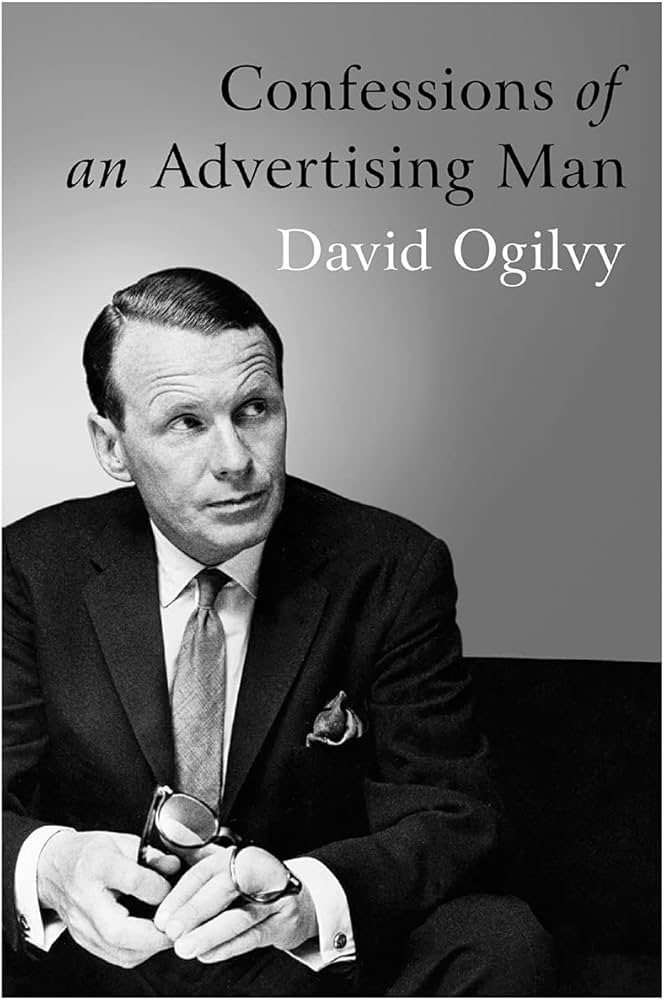
Book: Confessions of an Advertising Man by David Ogilvy: Amazon
Marketing Meditations is made at Dereva.