
Ogilvy / The settled mistakes playbook
The settled mistakes playbook
Nine principles from Confessions of an Advertising Man, and a way to sort your own marketing decisions into what is known and what is worth testing.
Principle 1 / Knowledge
Know what is settled before you test
"the discipline of knowledge to the anarchy of ignorance" - David Ogilvy
- A rule is compressed experience. Ogilvy answers the objection that rules make dull work by pointing to the sonnet and the sonata. Both are strict forms that produced great art.
- Knowing what fails is a fence. Much of marketing still needs exploring. Some of it is already known not to work, and knowing which leaves more room for the exploring.
- The name changes. Rules became frameworks, then playbooks, and now skills in AI tools. What matters is whether evidence sits behind the name.
Takeaway: Learn what is already known first, so your tests go to questions that are still open.
Principle 2 / Testing
Test what is still open, one variable at a time
"The most important word in the vocabulary of advertising is TEST." - David Ogilvy
- Ogilvy's list of what to test: the promise, the media, headlines and illustrations, ad size, frequency, spend and commercials.
- Most teams change five things at once. With pressure to do more with less, results get blended, and nobody can say which change moved them.
- Test markets put failure in a small place. Holdout groups and small submarkets are the modern version, and few teams use them.
Takeaway: Change one variable per test, and run it where a failure is cheap.
Principle 3 / Volume
More activity is not more results
"Bad advertising can unsell a product." - David Ogilvy
- Spend was the wrong variable. Ogilvy's statistician treated spend as the only factor, and missed that effective advertising at one-tenth the budget can outsell ineffective advertising.
- Some activity does harm. Repeated cold calls to the same accounts left a bad impression that lasted, and those prospects told others. Distasteful ads and negative talk about competitors work the same way.
- Incentives steer the advice. An agency paid on media spend leans toward advising more spend. Inside a company, attribution models do the same: people orient to whatever earns the credit.
Takeaway: Before adding volume, ask what the next unit is worth, and what the people who recommend it are paid to do.
Principle 4 / Promise
Lead with the outcome, and test which promise buyers choose
"promise, large promise, is the soul of an advertisement" - Dr. Johnson, quoted by Ogilvy
- Ogilvy tested promises directly. He put different promises on the package, asked buyers to rank cards, and built a series of ads around one promise each, then counted orders for each.
- A feature describes the product. A promise describes what the buyer gets, and buyers choose between promises.
- Show the result and let buyers draw the conclusion. Apple's Shot on iPhone campaign showed photos and left the specifications for later.
Takeaway: Write several candidate promises before you write the copy, and put at least two in front of buyers.
Principle 5 / Facts
Specifics are believable and set you apart
"Collecting facts is hard work." - David Ogilvy
- Believability. An oddly specific claim reads as true. "The best" reads as noise.
- Differentiation. If every competitor says "the best," the one that says how stands out. Ogilvy advertised facts that Shell and KLM shared with their rivals but that no rival mentioned.
- Expertise. In crowded markets, buyers want to know whether you can help them later. Specific detail shows you did the research.
Takeaway: Replace one superlative on your homepage with a fact only you can state.
Principle 6 / Compounding
Keep what works running, and build what compounds
"never give up a campaign just because you've grown tired of it" - David Ogilvy
- You see the campaign far more than your audience does. After three weeks you are tired of it, and most of your audience has not seen it yet.
- Keep winners in their own campaign. Pull the top-performing ads from each campaign into an evergreen one, so they keep running and stack up.
- Keep the next campaign in the ice box. When one is approved, start the next and hold it in reserve, so a flop does not cost a quarter.
- Brand lowers the cost of everything else. Price-off deals and lead generation aimed at this quarter's number fill the top of the funnel at the expense of later years. When I called an account, the reaction depended on whether they knew the company, not on the time of day or the script.
Takeaway: Run winners longer than feels comfortable, and keep the next campaign built.
Principle 7 / Proof
Earn belief with proof from other people
"the puffery of an anonymous copywriter" - David Ogilvy
- Nobody believes "number one in our category." Logo reels add some validation. Case studies add more when they name the company, the job title and the outcome.
- Buyers arrive asking "Are you for me?" They mean their role, their industry and their problem. Answer all three near the top of the page.
- People buy from people. Ogilvy advised showing the client's face and not the factory. Today that means a visible point of view and a named person behind the company.
Takeaway: Put a named customer result and a person's face where a visitor first lands.
Principle 8 / Medium
Make the work fit where it appears
"no need for advertisements to look like advertisements" - David Ogilvy
- Judge the layout where it will run. Ogilvy's version was to see it pasted into the publication. Ours is to see it in the feed or in search results.
- One ad on every platform ignores the audience. People scroll LinkedIn, Reddit and YouTube in different frames of mind, so a result on one does not carry to the others.
- Look like what people came to read. Ogilvy found ads styled as editorial pages drew about 50% more readers. Factual case studies written as native posts and video testimonials are the current form.
- Give video a shape. In Gallup's data, commercials that set up a problem, showed the product solving it, then proved it sold to four times as many people as ones that only preached.
Takeaway: Before you publish, look at the asset where it will appear.
Principle 9 / Judgment
Judge work by results, and use data for light
"as a drunkard uses a lamppost for support rather than illumination" - David Ogilvy
- Awards say little about results. Ogilvy noted that juries rarely see sales results, so they go by taste. Even inside a company it can be hard to learn whether a campaign worked.
- Data can be cover. Reports get used to support a decision already made. Judgment still has to decide what the data cannot, such as what image to build.
- Experts can say why. Ask why copy fails in reverse type. A real answer involves legibility and accessibility, and someone repeating a rule they heard cannot give it.
- Take rules with a grain of salt, and keep the reason. Ogilvy found photographs outsell drawings. With AI images everywhere, a drawing can now signal a human behind the work. The surface rule aged, and the psychology under it still holds.
Takeaway: Treat a rule as a hypothesis with a reason attached, and keep the reason when the rule ages.
The audit
Pick your last five assets: an ad, a landing page, an email, a case study, a video. Answer each question for each asset with Y, N or ?, then count the Ns and ?s. Each N or ? marks a decision worth a second look.
| Principle | Question | A1 | A2 | A3 | A4 | A5 |
|---|---|---|---|---|---|---|
| 1 Knowledge | Did we check what is already known about this format before we debated it? | |||||
| 2 Testing | If we tested it, did the test change one variable, in a small market or against a holdout? | |||||
| 3 Volume | Did we judge it on the quality of the result and not on volume or spend? | |||||
| 4 Promise | Does it lead with an outcome, chosen over at least one alternative? | |||||
| 5 Facts | Does it carry a specific fact that a competitor could not state? | |||||
| 6 Compounding | Is a winner still running, and is the next campaign ready? | |||||
| 7 Proof | Does it carry proof from a named person or company? | |||||
| 8 Medium | Did we review it in the place where it appears? | |||||
| 9 Judgment | Do we know the result, and can we say why it worked? |
Decision rule: apply it or test it
- The evidence can be checked (a study you can read, a test of your own, results data): apply it.
- The evidence is only authority (a famous name, a book): treat it as a hypothesis, and test it when being wrong is cheap.
- The rule rests on a psychological dynamic such as belief, curiosity or trust: keep the dynamic and adjust the surface rule to today's medium.
- No evidence either way: the question is open. Test it, one variable at a time.
Ogilvy's figures come from research of his era, as he reports it. Check any number against a current source before you rely on it.
Applied today
- 1. The evergreen campaign (Principles 2 and 6). I pull the top-performing ads from each campaign into one campaign I call the top performers. It runs as evergreen, so good ads keep serving and stack on each other, and I stop cycling through everything hoping the next campaign is a hit.
- 2. The case study as a native ad (Principles 7 and 8). Factual case studies written to read like a post in the LinkedIn feed, or a video testimonial placed where people already watch, are less disruptive than a standard ad. I have seen strong results, and they also build a pool of engaged viewers to retarget.
Keep the conversation going
Know what is already settled, test what is still open, and keep the reason when a rule ages.
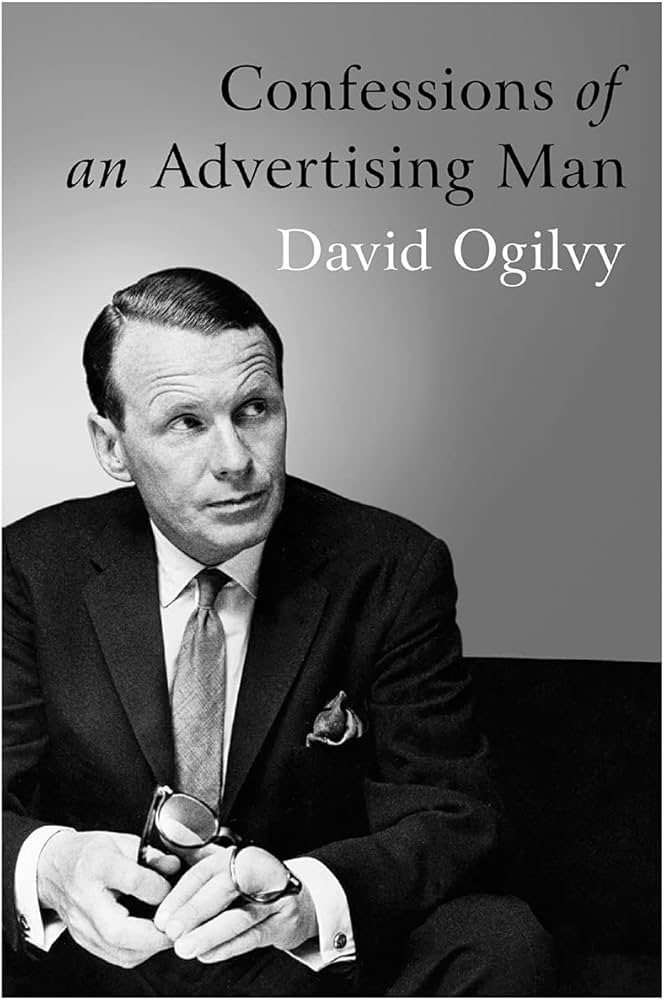
Book: Confessions of an Advertising Man by David Ogilvy: Amazon
Marketing Meditations is made at Dereva.